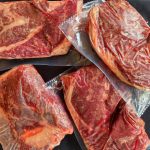
If you’ve noticed beef prices climbing at the grocery store, you’re not imagining it.
Across the country, families are asking the same questions:
- Why is beef so expensive right now?
- Is this just inflation, or something deeper?
- Will prices ever come back down?
The short answer: Today’s beef prices are the result of years of drought, biology, and market forces… not sudden price gouging or greed anywhere in the supply chain.
Understanding what’s driving prices up can help you make smarter decisions about how (and where) you buy beef for your family.
Why Is Beef So Expensive Right Now?
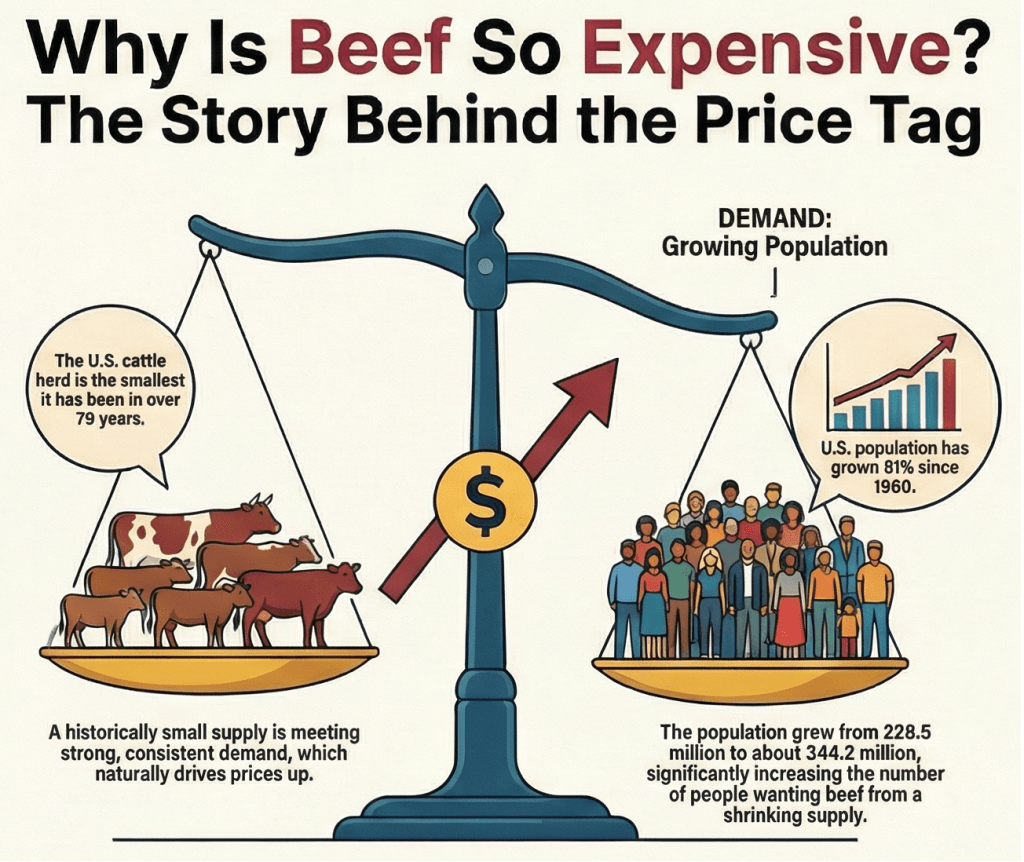
Beef prices are high because the U.S. cattle herd has shrunk to its smallest size since 1951… and rebuilding it takes years, not months.
According to the USDA’s January 2026 Cattle Inventory report, the total U.S. herd has fallen to just 86.2 million head. The beef cow herd specifically has dropped to 27.6 million head, a level not seen since 1961.
The result: beef costs have risen faster than nearly any other grocery item.
As of spring 2026, the numbers keep setting records. Ground beef reached an all-time high of $6.90 per pound in May, up roughly 19% in a single year. The all-beef retail average hit a record $9.64 per pound in April, up 13% year over year. Steak prices at many grocery chains now run $15–20 per pound for ribeyes and strips.
That’s not a blip. It’s the outcome of years of compounding pressures.
Even Costco Can’t Hold the Line (June 2026)
If you want one sign of where the beef market is, watch the store everyone trusts most on price.
Costco’s Kirkland Signature ground beef five-pack, about $25 two years ago, now rings up at $33.99 to $38.56 depending on location. Members have been vocal about it, and the story made national news this spring. When the lowest-priced beef in America has nearly doubled since 2019, that isn’t a store being greedy. It’s the cattle market underneath everyone.
You can see the mood in real time: “Just paid $12/lb for ground beef” recently topped r/Cooking on Reddit.

And the most-upvoted reply (from thousands of home cooks) was simply “I wouldn’t pay $12.”

Families aren’t quitting beef. They’re quitting unpredictable beef prices.
How Drought Forced Farmers to Liquidate Their Herds
Between 2020 and 2025, persistent La Niña-driven drought swept across the Great Plains and other key cattle-producing regions.
When pastures dry up, grass disappears, water sources shrink, and feed costs soar.
Faced with unsustainable costs, many ranchers made the gut-wrenching decision to sell their breeding animals… not because they wanted to, but because keeping them alive was no longer viable.
Some hauled water by the truckload. Others paid record prices to ship hay from hundreds of miles away.
Selling breeding cattle isn’t just a financial decision. For many farm families, it meant liquidating animals they had spent decades improving genetically: work that cannot be quickly replaced.
Those decisions reduced today’s beef supply, and the effects won’t fully unwind for years.
How Long Does It Take to Rebuild the U.S. Cattle Herd?
This is where most people are surprised.
If a farmer decides today to keep a young female calf (called a heifer) to grow the herd instead of selling her for beef, it takes about 30 months before that decision results in more beef in the food supply. And that’s under good conditions.
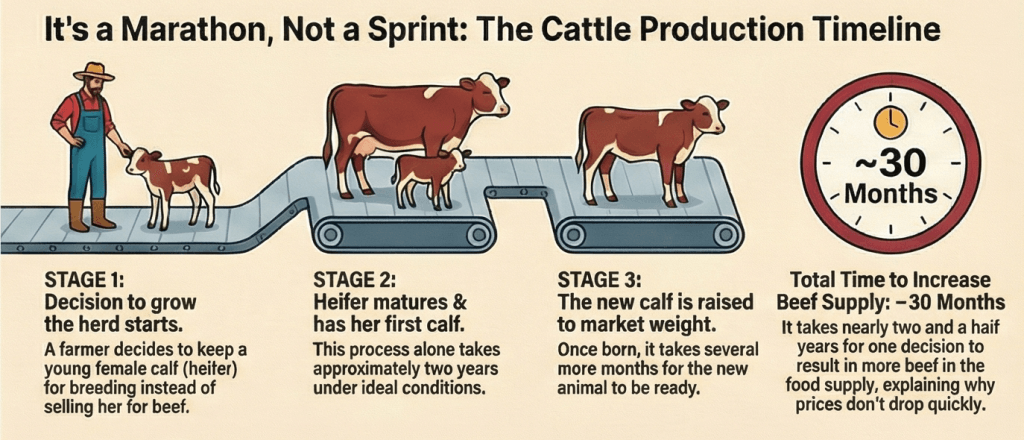
It’s a Marathon, Not a Sprint: The Cattle Production Timeline
| Stage 1 | Stage 2 | Stage 3 | Total Time to Increase Beef Supply |
| Decision to grow the herd starts | Heifer matures & has her first calf. | The new calf is raised to market weight. | 2.5 years |
| A farmer decides to keep a young female calf (heifer) for breeding instead of selling her for beef. | This process alone takes approximately two years under ideal conditions. | Once born, it takes several more months for the new animal to be ready. | It takes nearly two and half years for one decision to result in more beef in the food supply, explaining why prices don’t drop quickly. |
Analysts at Terrain Ag estimate that any meaningful herd expansion won’t reach the retail counter until at least 2028: keeping prices elevated for longer than most people expect.
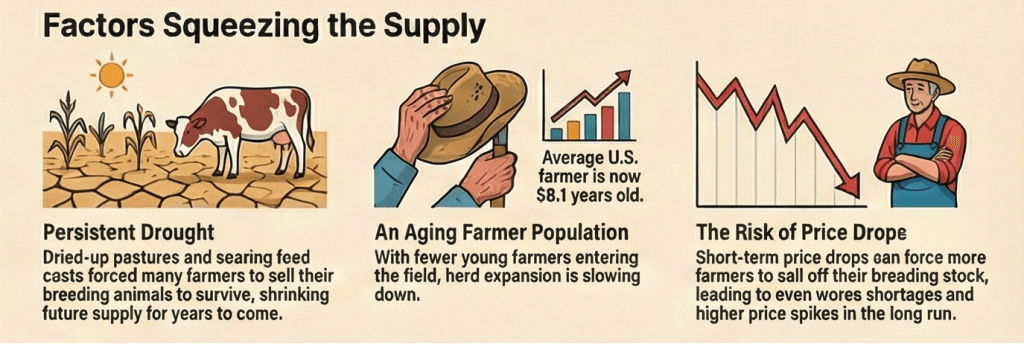
Factors Squeezing the Supply
- Persistent Drought: Dried-up pastures and searing feed casts forced many farmers to sell their breeding animals to survive, shrinking future supply for years to come.
- An Aging Farmer Population: With fewer young farmers entering the field, herd expansion is slowing down.
- The Risk of Price Drops: Short-term price drops can force more farmers to sell off their breeding stock, leading to even worse shortages and higher price spikes in the long run.
Making things slower: throughout 2025 and into 2026, many producers chose to capitalize on record cattle prices today rather than wait years for a new calf crop to mature. That decision has effectively extended the supply shortage well into 2027 and 2028.
New Factor in 2026: The Mexico Border Closure
One supply pressure your grocery store hasn’t explained: since late 2024, the U.S.-Mexico border has been closed to live cattle imports to prevent the spread of a flesh-eating parasite called the New World screwworm.
This closure has blocked roughly 1 million cattle from entering the U.S., which is a significant hit to feedlots and ranchers in the southern plains who relied on that supply.
Even if an agreement were reached to reopen, experts say any phased reopening would only gradually restore supply.
Rising Demand Is Making It Worse
Supply alone doesn’t explain prices. Demand matters too.
Despite record prices, Americans are still buying beef.
Federal sales data from early 2026 shows unit sales for beef down only about 4% year-over-year, while dollar sales were up 8%.
Demand for beef has not diminished. Beef is actually pulling wallet share from pork and chicken.
More people in the country also means more mouths to feed.
In 1980, the U.S. population was roughly 226.5 million. Today it’s about 344.2 million (a 51% increase) all competing for a shrinking beef supply.
More people means higher demand for the same limited supply, which naturally contributes to rising prices.
An Aging Farmer Population
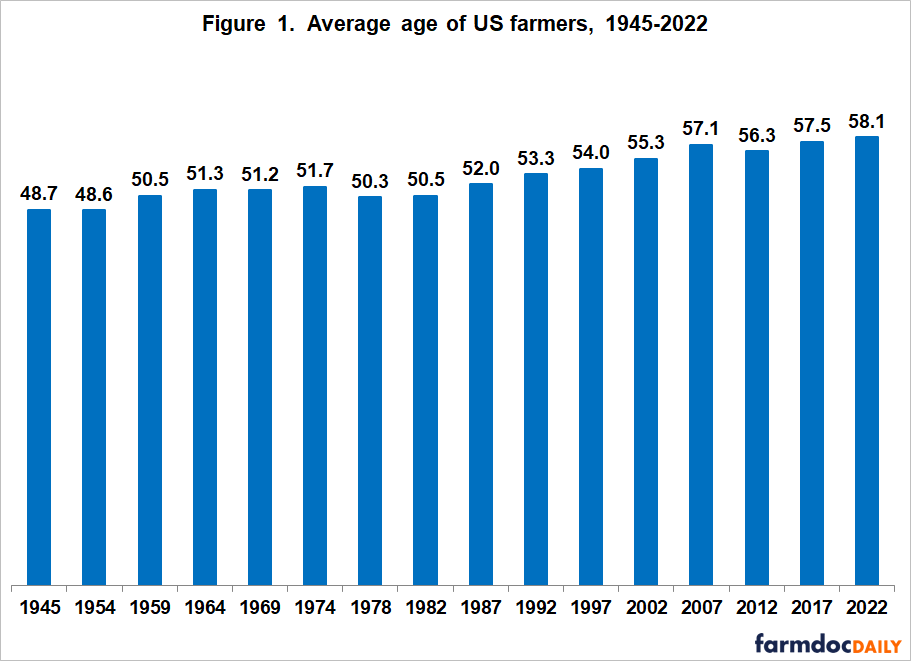
One long-term factor rarely discussed: the average U.S. farmer is now 58.1 years old, according to the 2022 Census of Agriculture (up 7.6 years since 1960).
Expanding a cattle operation today requires borrowing at high interest rates and paying record prices for additional cattle.
For many aging ranchers, selling animals at peak prices is more attractive than taking on debt to grow.
And for young farmers trying to break in, the barriers are steep.
This trend quietly reduces the pace of herd rebuilding across the country.
Will Importing More Beef Fix the Problem?
You may have heard that importing more beef from Argentina or other countries will bring prices down. The reality is more complicated.
Imports are primarily used for specific purposes, like balancing lean and fatty trimmings in ground beef.
Even the expanded Argentine import quotas announced in early 2026 represent a tiny fraction of total U.S. beef consumption and haven’t meaningfully changed market fundamentals.
Common Misconceptions Debunked
| Myth | Fact |
| Importing more beef will lower prices for everyone. | Imports are a small part of U.S. consumption, have little impact on retail prices, and can discourage American farmers from rebuilding their herds. |
| Beef prices should fall when general inflation slows down. | Beef prices are tied to the multi-year cattle production cycle, not just current economic trends. Supply must be rebuilt before prices can meaningfully decrease. |
When farmers see future prices fall from import competition, they’re actually less likely to invest in rebuilding their herds… which can make the long-term shortage worse, not better.
Why Beef Prices Stay High Even When Inflation Slows
These national trends show up locally as unpredictable grocery prices and limited availability.
For families in Northern Illinois, there’s an alternative worth understanding: buying beef directly from a local farm in bulk.
What buying direct actually offers:
- Price predictability. You lock in a price for a large quantity instead of watching per-pound prices move week to week.
- Cut averaging. A quarter or half cow gives you one blended price across steaks, roasts, and ground beef. Premium cuts that would cost $20–$30/lb at a grocery store are averaged in with everything else.
- Transparency. You know exactly where your beef came from, how it was raised, and what went into it.
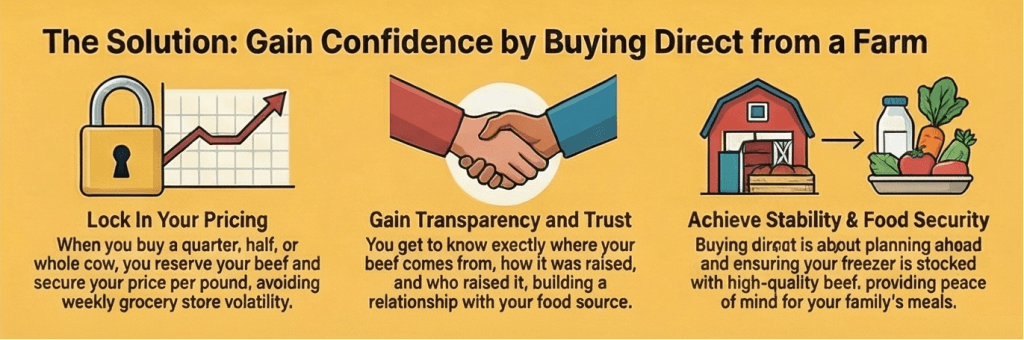
The Solution: Gain Confidence by Buying Direct from a Farm
- Lock In Your Pricing: When you a quarter, half, or whole cow, you reserve your beef and secure your price per pound, avoiding weekly grocery store volatility.
- Gain Transparency and Trust: You get to know exactly where your beef comes from, how it was raised, and who raised it, building a relationship with your food source.
- Achieve Stability & Food Security: Buying direct is about planning ahead and ensuring your freezer is stocked with high-quality beef, providing peace of mind for your family’s meals.
What it’s honest to say about cost:
Buying bulk beef from a local farm is not always cheaper per pound than grocery store ground beef.
Your effective price per pound includes ribeyes, roasts, brisket, and ground beef — all averaged together.
- If your family eats a wide variety of cuts, the value is real.
- If you’re mainly looking for ground beef, a bulk purchase may not pencil out the same way.
The real advantage is stability:
- knowing your price
- knowing your source, and
- not reacting to every shift in the grocery store meat case
How Nadig Farms Handles Pricing
Because beef production takes time and animal weights vary, we use a deposit-based system to reserve your portion of the animal.
Your final balance is based on actual take-home weight, not an inflated estimate or hidden markup.
What a share costs right now
One blended price per pound across everything: ribeyes, roasts, and ground.

Quarter Cow
Original price was: $12.50.$12.25Current price is: $12.25. per lb (Final Packaged Weight)
Half Cow
Original price was: $12.25.$12.00Current price is: $12.00. per lb (Final Packaged Weight)Whole Cow
Original price was: $12.00.$11.75Current price is: $11.75. per lb (Final Packaged Weight)

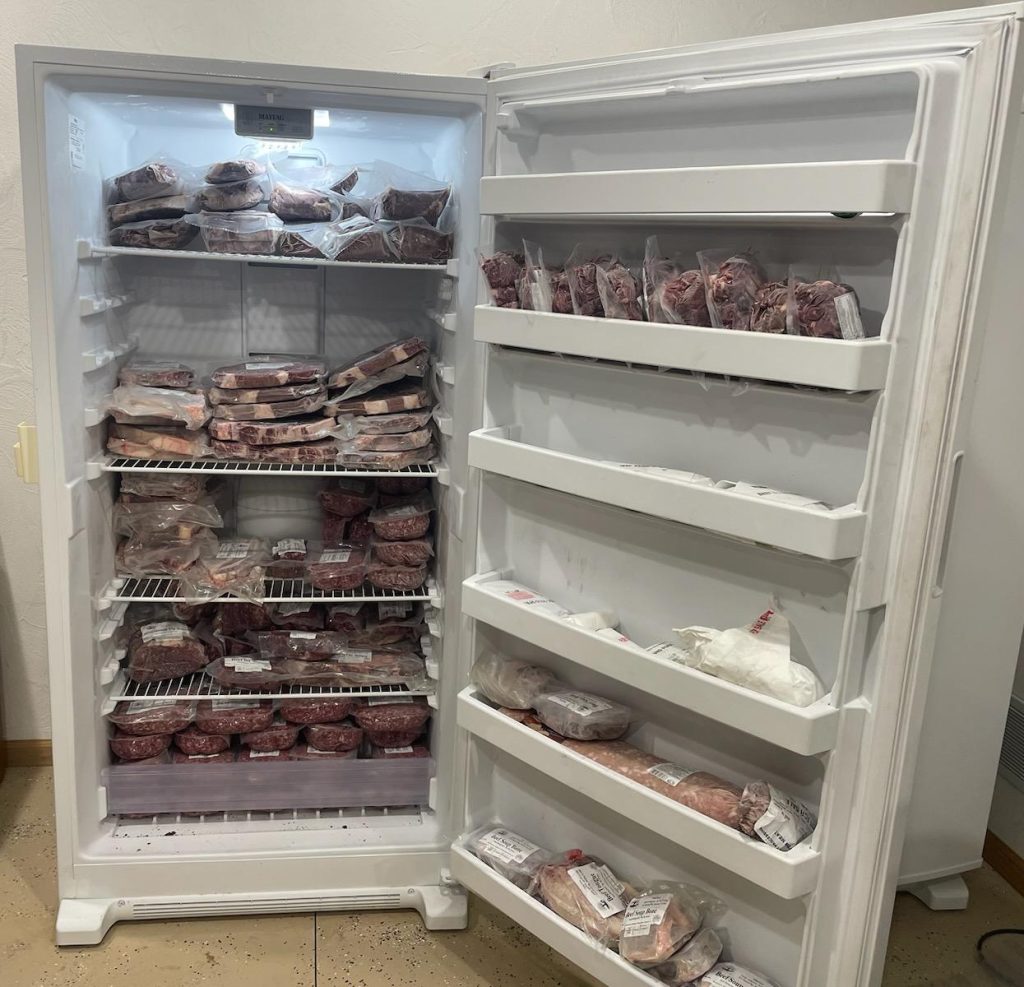
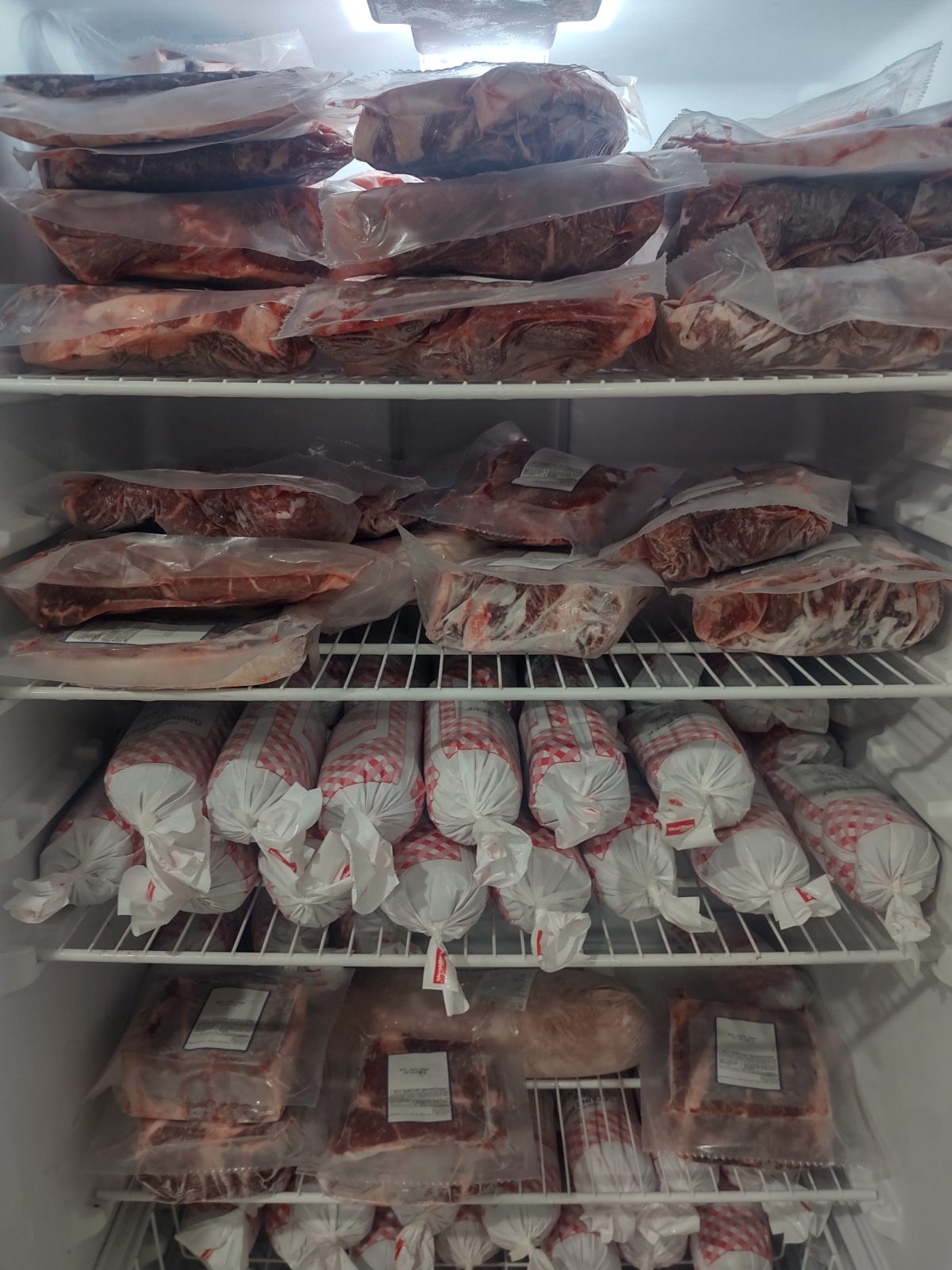
Your deposit locks today’s per-pound price for processing. If the cattle market keeps climbing between now and the date you lock in your deposit, your price doesn’t move. The deposit comes straight off your final balance.
Processing slots fill on a first-come basis. If you’re interested, visit our How It Works page or reserve your spot directly.